

Common Questions About Laser Hair Removal in Temecula
If you’re looking for real long-term reduction, yes, Laser Hair Removal can deliver it, but only when the treatment is planned correctly for your skin, your hair type, and your routine. That’s exactly what you’ll see in this blog.
I’m going to walk you through how the treatment targets the hair follicle, why results happen in stages, how many treatment sessions most people need, and what you should do before and after each visit to protect your skin and get cleaner results.
Because we’re in Temecula, one real factor we plan around is sun exposure. UV exposure can make skin more reactive, which is why timing and aftercare matter more than people expect. That doesn’t mean you can’t do this here. It just means you do it the smart way.
By the end of this guide, you’ll understand:
How the follicle-targeting process works and why results come gradually
What areas can be treated safely, including sensitive areas like the bikini line
How to tell if you’re a strong candidate, and what can temporarily disqualify you
What “permanent” really means in medical terms, and what maintenance looks like
Pain, downtime, side effects, and how we reduce risk
Pricing factors and how to compare packages without overpaying
No hype, no pressure, just a clear explanation so you can decide with confidence.
How the Follicle-Targeting Process Works
Laser energy targets pigment in the hair and heats the follicle so it grows back less, finer, or not at all over time.
What that means in real life:
The target is the hair follicle, not your whole skin surface
Darker, coarser hair is usually easier to treat than very light or fine hair
You’ll need multiple sessions because not all hairs are in the same growth phase
Why sessions are needed: only some follicles are in an “active” growth phase at any time, and that’s when the treatment is most effective.
If you want a deeper step-by-step breakdown covering prep, aftercare, and what’s normal between sessions, our complete laser hair removal guide is worth reading before you commit. It covers the full process in plain language so you walk in knowing exactly what to expect.
Treatment Areas and What’s Realistic by Zone
Most body areas can be treated, but comfort and timeline vary by location, hair density, and sensitivity.
Common areas clients treat first:
Underarms
Lower legs or full legs
Arms
Back or chest
Stomach line
Neck/jawline (requires careful planning)
Quick area expectations:
For the most accurate plan, we look at your hair thickness, color, skin tone, and how your skin reacts to irritation.
Candidacy Factors That Affect Results and Safety
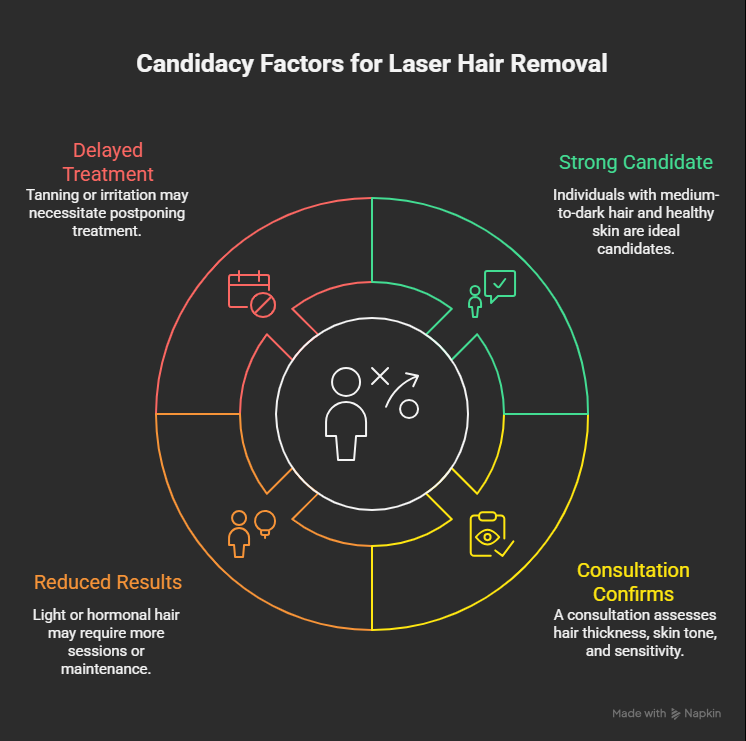
A question almost everyone asks early is, “How do I know if I’m a good candidate?” In most cases, you’re a strong candidate if your hair has enough pigment to target, your skin is healthy in the treatment area, and you can follow the basic rules that protect results, especially avoiding tanning and sticking to proper session spacing.
A consultation helps confirm the details, including hair thickness, skin tone, sensitivity, and the safest treatment settings for you.
Strong candidate signs:
Hair is medium-to-dark and relatively coarse
Skin is not tanned or sunburned
You can avoid waxing/plucking during your series
You can commit to consistent session spacing
Situations that can reduce results (or require more maintenance):
Very light, red, gray, or white hair (less pigment to target)
Fine facial hair (often slower progress)
Hormonal fluctuations (can trigger new growth patterns over time)
When we usually delay treatment (temporary):
Recent tanning (including spray tan/self-tanner)
Sunburn or active irritation/rash in the treatment area
Certain photosensitizing meds or skincare routines (we’ll review these)
Another very practical question is who should not do laser hair removal right now. Most of the time, it’s not a permanent “no,” it’s a timing issue. Our detailed breakdown of laser hair removal candidacy factors covers each disqualifying situation and what needs to happen before treatment can safely move forward.
Laser Types, Settings, and Why Wavelength Matters
The device matters, but the combination of device + settings + provider experience matters more.
Here’s the practical version: different wavelengths interact differently with pigment and depth. That’s why personalized settings are a safety issue, not a luxury.
Common laser categories:
Two safety standards that should always be present:
Cooling support (to protect the skin surface and improve comfort)
Protective eye gear and strict boundaries (especially on facial areas)
Choosing the right laser for your specific combination of skin tone and hair color is one of the most important decisions in this process. Our guide on matching the best laser to your skin and hair type goes deeper on how each wavelength performs across different profiles so you can have a more informed conversation with your provider.
Sessions and Results Timeline
Before you decide anything, it helps to set expectations correctly: most people need a series, and results build over time.
Our clients commonly fall in the 6–9 session range, often spaced 4–6 weeks apart depending on the area and your growth pattern. Most frustration comes from not knowing what “normal progress” looks like.
What progress usually looks like:
The laser hair removal results timeline makes it clear what changes to expect after each session, session by session, so you can judge your own progress fairly instead of second-guessing whether things are on track.
Comfort, Pain Level, and Downtime
One of the biggest questions people ask before booking is whether it hurts and whether there’s downtime. Most clients describe laser hair removal as quick heat with a snap-like sensation rather than prolonged pain, and downtime is usually minimal.
Comfort depends on the area being treated, hair density, your sensitivity that day, and how well the device cooling and technique are used.
What changes comfort most:
Treatment area (upper lip usually feels sharper than legs)
Hair density (dense areas can feel stronger)
Cooling features and technique
Your sensitivity that day
What’s normal right after:
Mild redness
Slight swelling around follicles
Warmth/sensitivity for a few hours
Most people go back to normal routines quickly, but we typically recommend avoiding heavy friction, heat exposure, and intense workouts for a short window if your skin runs reactively.
Side Effects and How to Keep Them Rare
Common, short-term side effects:
Redness
Mild swelling
Temporary sensitivity
Less common risks (more likely with tanning or overly aggressive settings):
Blistering/crusting
Pigment changes
Scarring (rare)
Risk reduction checklist:
Avoid tanning before and during your series
Follow aftercare (especially sun protection)
Choose a provider who adjusts settings to your skin, not a preset template
That last point deserves more attention than most clients give it. Our guide on how to choose the right laser hair removal provider gives you a practical checklist of questions to ask during consultation, including what screening, device standards, and aftercare protocols should look like before you commit.
Preparation and Aftercare in Temecula
If you’re asking what to do after treatment to protect your skin, this is the section that matters most. In Temecula, sun protection is one of the biggest factors in preventing irritation and pigmentation issues after laser hair removal. Good aftercare is not complicated, but it does need to be followed consistently, especially if you spend time outdoors.
Before your appointment:
Shave the area 12–24 hours before (do not wax or pluck)
Arrive with clean skin (no oils/lotions on the area unless instructed)
Avoid tanning and heavy UV exposure leading up to the session
Tell us about meds and skincare products you’re using
After your appointment:
Keep the area cool and calm (aloe is often helpful)
Avoid hot tubs/saunas and heavy friction for a short period
Avoid tanning beds and direct sun exposure on treated skin
Use SPF 30 sunscreen (and cover treated areas when practical)
Pricing Factors and How to Compare Packages Without Regret
Pricing varies because your plan should match your actual needs, not a generic guess.
If you want a clear breakdown before your consultation, our guide to laser hair removal costs and what’s included in a package covers per-session pricing, package structures, and financing options so you can compare properly and avoid paying for sessions you don’t need.
Why Many Temecula Clients Choose Our Approach
Clients want results, but they also want safety and consistency, especially when skin tone, sensitivity, or sun exposure is part of the picture. It’s worth knowing that laser hair removal devices are regulated as medical devices in the United States. The FDA’s guidance on laser hair removal device safety and cleared indications outlines what proper use looks like, and it’s a useful benchmark when evaluating any provider you’re considering.
Here’s what we focus on:
Clear screening and honest candidacy guidance
Medical-grade standards for energy-based treatments
Personalized settings, not one-size-fits-all
A brand-new, state-of-the-art facility and a client-first experience
For an independent clinical perspective, the American Academy of Dermatology’s overview of laser hair removal is a well-regarded reference on realistic outcomes, safety, and what the standard of care looks like, useful context when comparing your options.

Conclusion
If you want a smoother routine, fewer ingrowns, and long-term reduction, Laser Hair Removal can be a strong option, as long as your plan matches your skin, hair, and lifestyle.
The key is simple: choose a provider who screens you properly, personalizes settings, spaces sessions correctly, and gives you aftercare rules that actually protect your skin, especially in a sunny climate like Temecula.
When you’re ready, book your consultation with LeVogue Med Spa in Temecula, CA at Le Vogue Medspa or call (951) 944-2546. Visit us at 27645 Jefferson Ave, Suite 104B, Temecula, CA 92590 (Mon–Fri 10am–6pm, Sat 10am–4pm).