
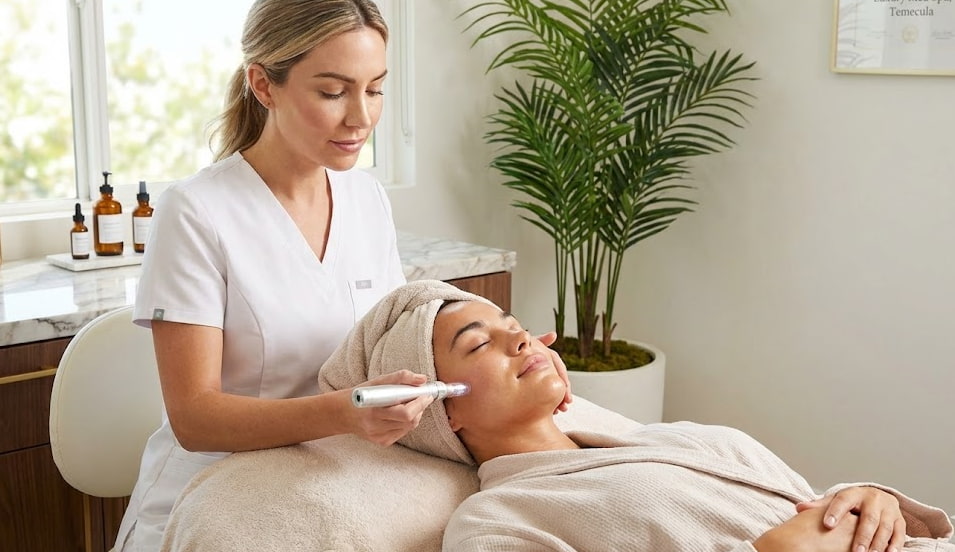
Common Questions About Microneedling in Temecula
If you’ve been thinking about microneedling, you probably have the same set of practical questions we hear every week. You want to know what it actually does to your skin, whether it hurts, what the downtime looks like, and what kind of results you can realistically expect. You might also be wondering whether it helps with acne scars, enlarged pores, or uneven tone, and whether adding PRP is worth it or just an expensive add-on.
Microneedling works by stimulating collagen, but results build gradually. That’s why outcomes depend on the right candidate, the right technique and device, and the right aftercare. When any of those are off, results can be weaker and irritation becomes more likely. So I’m going to walk you through microneedling the same way I would if you were sitting across from me:
How microneedling triggers collagen and elastin changes
Which concerns it treats best, and where it has limitations
What pain management looks like with topical numbing
A realistic recovery timeline and aftercare expectations
How many sessions you typically need for your goal
Safety considerations for different skin types and tones
The real differences between classic microneedling and RF microneedling
How PRP fits in, and who should skip it
The most common side effects, plus the risks you should understand upfront
By the end, you should feel confident about whether this is a good next step for you. If you want a comprehensive overview before diving into the FAQs, our complete microneedling guide covers the full picture from start to finish.
What Is Microneedling and How Does It Actually Work?
Microneedling is a controlled procedure that creates tiny micro-injuries in the skin using sterile needles. Those micro-injuries trigger your skin’s natural repair mechanism, which is what supports collagen production, elastin deposition, and gradual tissue regeneration over time.
In plain language, you are not “damaging” your skin in a random way. You are giving it a measured signal to rebuild in a smoother, more organized pattern. That is why microneedling is often discussed as Collagen Induction Therapy.
Two timing details matter here:
Results are not instant, because collagen continues to form for months. Many reviews note that collagen deposition and remodeling can continue for roughly 3 to 6 months after a treatment series.
Microneedling is typically done in a series, because the collagen signal works best when it’s consistent, not when it’s “one and done.”
A simple analogy I use is lawn aeration. You create small channels, the system responds, and over time the surface becomes healthier and more even. Your skin works similarly when the treatment is done correctly.
What Skin Concerns Can Microneedling Treat Effectively?
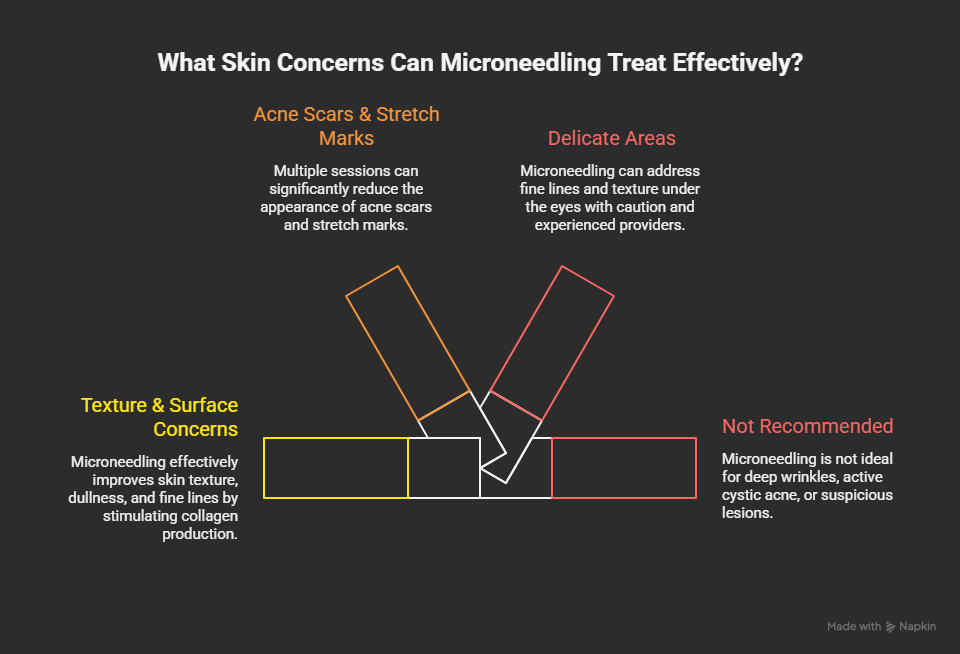
Microneedling tends to work best when your concern is tied to texture, shallow to moderate scar tissue, early lines, or the overall “quality” of the skin surface.
The most common concerns it can help with include:
microneedling for acne scars (especially rolling and boxcar scars, results vary by scar type)
enlarged pores and pore size concerns
uneven skin texture and dullness
fine lines and early skin aging
some stretch marks and certain scars depending on depth and location
If acne scarring is your main goal, published dermatology sources describe meaningful improvement after multiple sessions, with many studies reporting scarring improvement in the 50–75% range for a large portion of patients when the treatment plan is appropriate.
Another common question is whether microneedling can be done under the eyes. The answer is yes, but only with conservative depth and an experienced provider because the under-eye area is thinner and more sensitive than other parts of the face.
It may help improve fine lines and skin texture in that area, but it does not correct true hollowness caused by volume loss, which usually requires a different treatment approach.
Where microneedling is often not the best first tool:
Very deep wrinkles that require more aggressive resurfacing or structural support
Active cystic acne or active infection in the treatment area
Certain skin conditions where inflammation is not well-controlled
Lesions that need a medical diagnosis first (for example suspicious scaly patches that could be actinic keratosis)
If you’re on the fence about whether your specific concern qualifies, our detailed breakdown of good candidates for microneedling walks through the skin types, scar categories, and health factors that make the biggest difference in how your results turn out.
Someone comes in asking for “pore shrinking,” but what they actually need is a plan that targets texture plus oil management plus consistent aftercare. Once we frame the problem correctly, microneedling becomes either the right choice, or we decide it should be paired with something else, like chemical peels or another resurfacing option.
How Painful Is Microneedling, Really?
If needles are the part you’re stuck on, that’s completely normal.
Most people tolerate microneedling well because we use topical numbing cream, and we tailor depth and technique to your comfort and your goal.
Clinical comparisons of topical anesthetics used for skin microneedling procedures report average pain scores around the 4/10 range depending on the numbing agent and procedure specifics.
Here’s what changes the sensation the most:
Treatment area: forehead, upper lip, and bony areas feel stronger than cheeks
Depth: deeper passes for scarring feel more intense than a lighter rejuvenation session
Skin condition that day: dryness, irritation, or recent sun exposure can make you feel more
Technique and pacing: steady, controlled passes matter
What you should expect is more like a strong “scratchy vibration” or prickling, not sharp stabbing pain. If you’ve ever had a mildly abrasive facial treatment, it’s closer to that category than most people imagine.
What Is the Downtime and Recovery Like After Microneedling?
Let me make this simple, downtime is usually about redness, sensitivity, and dryness, not being “out of commission” for a week.
A commonly cited recovery window is about five to seven days for the skin to fully settle, with the most noticeable redness and sensitivity happening early.
A realistic timeline often looks like this:
Day 1: redness like a sunburn, warmth, tightness
Day 2–3: redness calms, mild swelling may linger, dryness can start
Day 4–7: light flaking can happen, texture begins to smooth, skin looks more normal
A question that comes up often during recovery is whether microneedling can cause breakouts or “purging.” It can happen, especially if you’re acne-prone, sweat heavily after treatment, or restart active skincare too soon.
In many cases, it’s temporary and related more to irritation or product timing than the treatment itself. If you have active cystic acne, it’s usually better to calm inflammation first before scheduling microneedling.
Where Temecula makes a difference is sun exposure. UV radiation is a major variable in healing and pigmentation, so aftercare is not optional if you want an even, predictable result.
A practical aftercare baseline is:
Gentle cleanser, no scrubs
Barrier support and hydration (many people do well with hyaluronic acid serum)
Mineral SPF daily, zinc-based sunblock is a common go-to
Avoid heat, heavy sweating, and direct sun early on
Another important aftercare question is when to restart stronger products like retinol or vitamin C. In most cases, it’s best to wait until redness and sensitivity have fully settled. A common range is about 5–7 days, but healing varies by skin type and treatment depth. Restarting too early can increase irritation and prolong recovery.
If you want a detailed, step-by-step breakdown before you decide, take a look at our microneedling aftercare tips on our site. It covers product timing, sun protection, and what to avoid so your results stay clean and predictable.
How Many Sessions Do You Need and When Will You See Results?
Most people need a series, especially if the goal is scarring, pore refinement, or visible texture change.
A common treatment plan is 3–6 sessions, spaced about 4–6 weeks apart, because collagen continues forming gradually and needs time between sessions.
Here’s what I want you to expect realistically:
Early changes: some people notice a “glow” or smoother feel within a couple of weeks
Mid-series changes: texture and pore clarity often improve after the second or third treatment
Peak results: collagen remodeling continues for months, so your best result is often later, not immediately after session one
For a visual breakdown of what to expect week by week and session by session, our microneedling results timeline maps out the milestones so you can track progress without second-guessing the process.
If you also get Botox or dermal fillers, timing matters. Microneedling done too close to injectables can increase swelling, irritation, and discomfort, so it’s important to space treatments appropriately and share your recent injectable dates during consultation. The exact timing can vary depending on what was treated and how your skin responds, which is why treatment sequencing should be planned instead of guessed.
The same idea applies if you’re considering chemical peels or laser resurfacing. Microneedling can sometimes be combined with other resurfacing treatments, but it should be sequenced carefully, not stacked randomly. Doing multiple aggressive treatments too close together can increase irritation and pigmentation risk, especially if you have sensitive skin or are prone to post-inflammatory hyperpigmentation.
Is Microneedling Safe for All Skin Types and Tones?
In general, microneedling can be a safer choice across a wide range of skin tones compared to some heat-based resurfacing options, because it relies on mechanical stimulation rather than aggressive thermal injury.
That said, “safe” depends on protocol. Your skin tone, your tendency toward pigmentation, your history of inflammation, and your aftercare habits all matter.
Two points worth knowing:
Some reviews note microneedling is often used broadly across skin types and tones when done correctly, including in people who are more prone to pigmentation changes.
Pigmentation changes are still a known risk category with microneedling devices, especially if technique and aftercare are poor.
If you are prone to post-inflammatory hyperpigmentation, you’re not automatically “not a candidate.” It just means the treatment plan needs to be conservative, your sun protection needs to be consistent, and your topical routine needs to be managed intelligently during healing.
Microneedling vs. Radiofrequency Microneedling – What’s the Difference?
Classic microneedling works through controlled micro-injuries that stimulate collagen remodeling. Radiofrequency microneedling adds energy (heat) through the needles. That heat can increase tightening effects for some people, especially if laxity is part of the concern, but it also raises the importance of device settings and provider skill.
Here’s a clean comparison:
One reason I bring this up transparently is that in October 2025, the FDA published a safety communication about reports of serious complications with certain uses of RF microneedling devices, including burns, scarring, fat loss, disfigurement, and nerve damage.
That does not mean RF microneedling is “bad.” It means you should treat it like a medical procedure, not a casual add-on.
If you want to see how to evaluate provider qualifications and safety signals before booking, our guide on how to choose a qualified microneedling provider breaks it down in a simple checklist format so you know exactly what questions to ask.
Microneedling with PRP – Who Is a Good Candidate?
Microneedling with PRP is essentially microneedling plus Platelet-Rich Plasma, a concentration of your own platelets that contains growth factors involved in healing and tissue regeneration.
The fairest way to describe PRP is that it can enhance outcomes for certain people, especially when scarring and repair are the focus, but it is not mandatory for everyone.
A meta-analysis looking at microneedling combined with PRP for acne scars found the combination was more effective than microneedling alone, without a clear increase in severe adverse events in the datasets they analyzed.
In most cases, you’re a good candidate for PRP if:
You’re generally healthy and okay with a simple blood draw
Your goal is skin repair, not instant “overnight” change
You’re treating concerns like scarring, uneven texture, or dull tone
You’re willing to follow post-treatment care properly, especially sun protection
You may not be a good candidate for PRP if:
You have medical restrictions around blood draws
You have clotting-related issues or blood-related conditions
You currently have an active infection or active inflammation that affects healing
Your health history makes healing unpredictable (this is something we screen for)
What can disqualify someone from PRP:
It’s usually medical, and it shows up during intake screening
If there’s uncertainty, the safest approach is proper evaluation instead of guessing
The goal is to avoid doing PRP when it could increase risk or give poor results
The best candidates for PRP usually have:
Realistic expectations (gradual improvement, not immediate transformation)
A repair-focused goal (like collagen support, scar softening, and tone improvement)
Strong consistency with aftercare, especially sun protection and skincare timing
About age, here’s the honest answer: there’s no “right age” for PRP. It makes sense when your skin condition and your goals support it. The decision is based on need and eligibility, not a number.
If you have post-acne scarring that has been stable for years and you’re investing in a series anyway, PRP can be a smart add-on. If your main issue is deep volume loss or significant laxity, your money may go further with a different treatment choice.
What Are the Real Risks and Side Effects of Microneedling?
You deserve a transparent answer here.
Most side effects are expected and temporary: redness, swelling, dryness, tightness, flaking, and mild discomfort.
The “real risks” are less common, but they exist:
Pigmentation changes: hyperpigmentation or hypopigmentation can happen, especially with poor aftercare or aggressive treatment settings
Infection: uncommon when sterile technique and aftercare are followed, but it is a known risk category
Cold sore reactivation: can occur in susceptible individuals
Worsening irritation: usually from using the wrong active skincare products too soon
For authoritative context on what device clearance actually means in practice, the FDA’s overview of cleared microneedling devices and their indications is a useful reference, especially when comparing providers who use different equipment.
If you have an active skin infection, uncontrolled inflammatory acne, or a concerning lesion that needs diagnosis first, microneedling should wait. When it’s done at the wrong time, it’s not just less effective, it can become avoidably risky.
Why Choose LeVogue Med Spa for Microneedling in Temecula?
Microneedling results are rarely about the treatment alone, they come from the right plan, the right technique, and the right follow-through. At LeVogue Med Spa, we focus on doing the small details correctly, because that’s what makes your outcome more predictable.
Why clients choose us for Microneedling in Temecula:
Personalized treatment plan: We adjust needle depth, pass technique, and session spacing based on your skin type, scar tissue, and goal, so you’re not stuck in a “one-size-fits-all” routine.
Medical-grade microneedling standards: We use sterile, professional microneedling technology and follow clean protocols, which lowers avoidable risk and helps your skin heal the way it should.
Better guidance on treatment choices: If microneedling isn’t the best standalone option for your concern, we’ll explain that clearly, and help you compare it with chemical peels, PRP therapy, or CO2 laser resurfacing so you don’t choose the wrong path early.
Aftercare support designed for Temecula sun exposure: We take post-treatment care seriously because UV exposure can interfere with healing and tone. You’ll leave with simple, clear instructions that protect results, not vague advice.
Comfort-first experience for nervous clients: Many first-time clients feel anxious about needles. Our environment is calm, welcoming, and yes, pet-friendly, which helps people relax and stick to the plan instead of rushing through it.

Conclusion
Microneedling can be a practical option for smoother texture, softer acne scars, and refined pores, as long as you follow a proper series and aftercare. PRP or RF microneedling can help in the right cases, but only with proper screening and safe technique.
Contact LeVogue Med Spa, Temecula, CA at (951) 944-2546, visit 27645 Jefferson Ave, Suite 104B, or book at Le Vogue Medspa.